How to Build a Secure RAG Application for Enterprise Data
AI use in businesses is growing faster. But as more organizations explore Retrieval-Augmented Generation (RAG) to power internal knowledge tools,
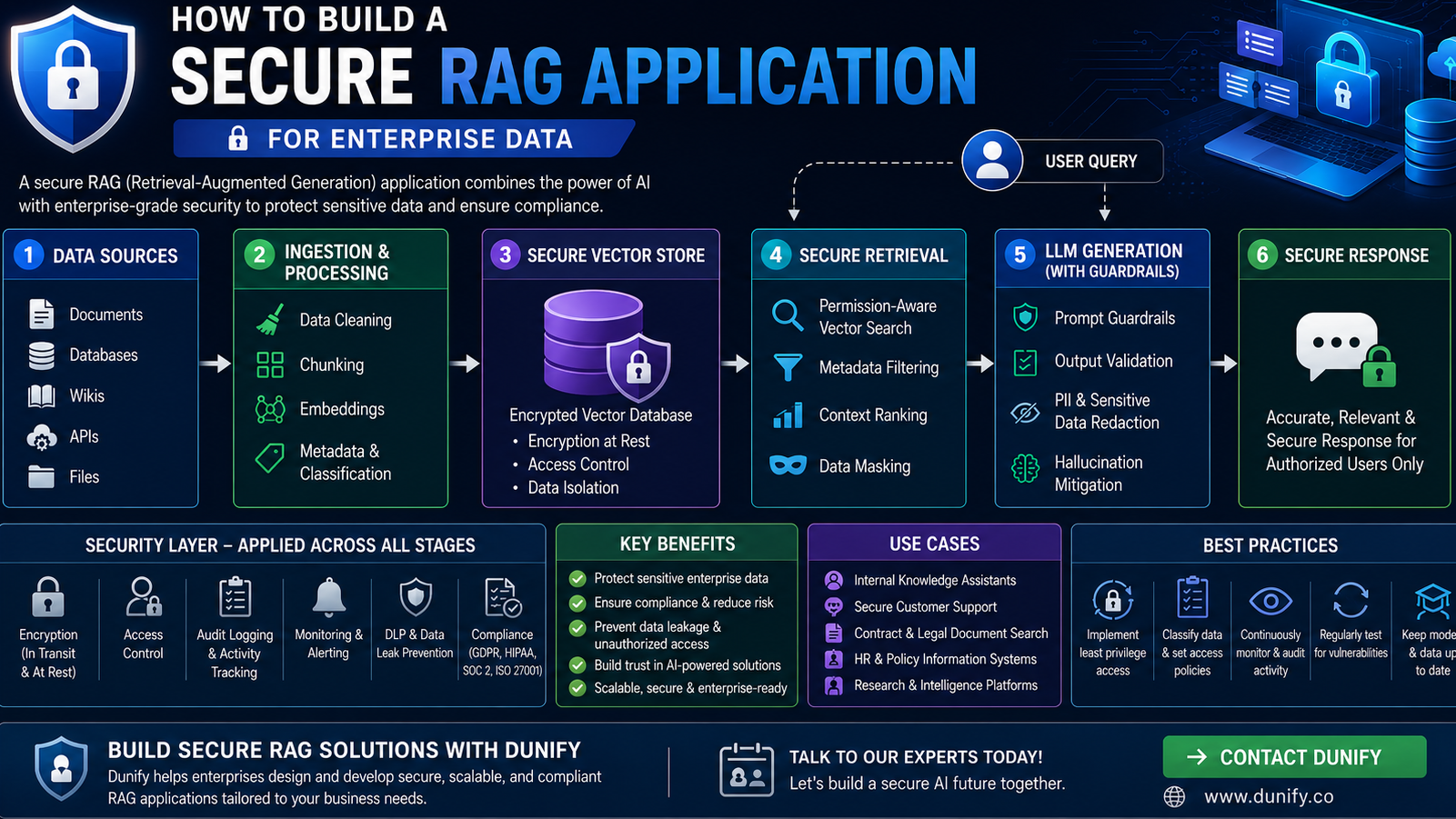
Layered security controls are needed to make a RAG application safe for enterprise data. These controls cover data ingestion, access management, vector database selection, and retrieval guardrails. Businesses that build RAG architecture with security in mind from the start lower their chances of data loss, breaches of security, and noncompliance.
AI use in businesses is growing faster. But as more organizations explore Retrieval-Augmented Generation (RAG) to power internal knowledge tools, customer-facing assistants, and operational workflows, one question keeps surfacing in boardrooms and engineering teams alike: how do we make sure our sensitive data doesn't end up in the wrong hands?
By giving AI models access to private documents, company databases, and real-time information, RAG application development unlocks a lot of business value. The problem is that RAG systems that aren't properly protected can let out private contracts, customer records, financial information, or intellectual property. Not thru a big security hole, but thru small, hard-to-find retrieval mistakes or access controls that aren't set up right.
This guide shows you step-by-step how to create a safe RAG application that is designed to handle business data, from planning the architecture to keeping an eye on it.
Why Enterprise Data Needs a Secure RAG Architecture
Most general-purpose AI systems are trained on public data. Enterprise RAG apps are not the same. They get your private information from internal wikis, HR documents, legal filings, product specs, and customer records and use it to write responses.
Because of this difference, security duties are created that aren't present in market AI situations. Regulatory frameworks such as GDPR, HIPAA, and SOC 2 have strict rules about how to store, access, and process sensitive data. A RAG application that retrieves employee salary information for an unauthorized user, or surfaces a confidential acquisition document during a routine query, isn't just a technical failure, it's a compliance and reputational risk.
Secure RAG architecture means that every part of the system is built with data security in mind, even before the first document is loaded.
What Makes a RAG Application Secure for Enterprise Use?
A secure RAG application isn't defined by one feature it's the result of multiple, reinforcing controls working together. At a high level, business RAG security covers:
Data isolation means making sure that each person or group can only get the data they are allowed to see.
Encrypted storage: protecting data at rest and in motion within vector databases
Retrieval guardrails: preventing the AI from generating answers that reconstruct or reveal restricted information
Audit logging: keeping a record of every request, answer, and retrieval so that they can be tracked
Monitoring and alerting: finding strange patterns of retrieval before they become problems
You don't have to get these extras. For regulated fields like finance, healthcare, and the law, these are basic requirements.
How to Design a Secure RAG Architecture
Start With a Zero-Trust Mindset
The most reliable corporate RAG architectures treat every part as if it could be hacked. Zero-trust means that no person, service, or internal system gets extra rights by default. Access is checked all the time, not just when you log in.
This means that in RAG application development, you need to authenticate before retrieving, enforce permissions at the vector search layer as well as the application layer, and check each answer before sending it to the user.
Separate Data by Sensitivity Level
Some business info is more likely to be stolen than others. A good design pattern is to divide your document corpus into groups like "public," "internal," "confidential," and "restricted," and then keep separate vector stores or namespaces for each group. After that, queries are sent only to the stores that the user is allowed to access.
This stops a common failure mode called "over-retrieval," which happens when a broad query brings up documents that the user who asked for them shouldn't see.
Securing Enterprise Data During RAG Data Ingestion
Data ingestion is where many RAG security issues originate. When documents are broken up into chunks, kept in a vector database, the metadata that goes with each chunk should include the document's source, classification, and owner.
Getting rid of information during ingestion is a quick fix that leads to real problems later on. Without it, the retrieval layer can't make sure that document-level rights are followed when a query is made.
Some of the best ways to ensure secure ingestion are:
Tag each chunk with access control metadata before embedding
Scan papers for private patterns (PII, credentials, regulated data) prior to indexing
Keep track of every file that is added to the vector store, including when and who initiated the entry.
Access Control and Permission Management in RAG Applications
Role-Based and Attribute-Based Access Control
Enterprise RAG applications typically need both role-based access control (RBAC) and attribute-based access control (ABAC). RBAC gives permissions based on job function. For example, a sales rep can get content that deals with customers, and a finance analyst can get papers about revenue. ABAC goes even further by using dynamic attributes like membership in a project, department, or location to make more specific decisions about who can access what.
It is very important to control access at both the UI and the retrieval layer. A user who can't access a document through the program should not be able to access it through a direct API query either.
Propagating User Identity Through the RAG Pipeline
It's not always easy to make sure that the user's name is carried over from the query interface to the vector search in enterprise RAG development. A lot of ready-made RAG frameworks use a single shared service account for retrieval, which means the vector database doesn't know who is asking. When used in a corporate setting, each retrieval request should include the verified user's name and permissions, which should be applied dynamically during the search.
How to Protect Sensitive Data During AI Retrieval
There is a unique risk in the retrieval step: even if only relevant chunks are returned, an AI model could put them together in a way that gives the user information they shouldn't have. For example, a model could confirm the existence of a confidential project by combining partial references from multiple documents.
Some ways to reduce the damage are:
Output filtering: scan AI-generated replies for sensitive patterns before delivery
Citation controls: limit responses to clearly retrieved content, reducing inferential leakage
question-level logging: keep track of what was returned for each question so that audits can be done after the fact if a data breach is suspected.
Choosing the Right Vector Database for Secure RAG
Not all vector databases are built with business security in mind. When looking at your secure RAG application options, give the following the most weight:
Level of namespace or collection Being able to properly separate data by team, classification, or tenant is called isolation.
At rest and while in transit, encryption is a basic need for any regulated setting.
Metadata filtering at query time: important for enforcing document-level access control
Support for audit logs: some databases have built-in query logging, while others need external instrumentation.
Pinecone, Weaviate, and Qdrant each offer varying degrees of these capabilities. Which one to choose depends on how you want to deploy it (cloud vs. self-hosted), your compliance needs, and the size of your document corpus.
Preventing Data Leakage and Unauthorized AI Responses
Data leakage in RAG systems rarely looks like a major breach. Most of the time, it's an AI response that has a client name that shouldn't be shown, a price number from an internal proposal, or an HR document with a decision about hiring someone.
To stop this from happening, you need defense in depth, which means that tight ingestion tagging, permission-aware retrieval, and output scanning all need to work together. Not a single control is enough by itself.
For very private deployments, think about adding a review step with a person involved for legal, financial, or executive-level queries that are high-risk before the answers are sent.
RAG Security Challenges Enterprises Should Plan For
During enterprise RAG development, a number of problems keep coming up:
Prompt injection is the use of malicious inputs to change the process of retrieval or generation. Mitigate with input validation and prompt hardening.
Chunk boundary leakage is when a chunk of a document contains data from a restricted section next to it. Careful chunking and boundary-aware metadata tagging were used to solve the problem.
Model memorization: base models may keep training data in fine-tuned RAG variants. For sensitive applications, use retrieval-only RAG as much as possible and don't fine-tune on private corpora.
Third-party API risk: If your RAG pipeline sends queries thru external LLM APIs, the data sent in prompts may be subject to the provider's rules about how long it can be kept. Review these carefully against your compliance requirements, or deploy models in your own infrastructure.
How to Test and Monitor RAG Application Security
The following should be part of security tests for RAG systems:
In red-team exercises, you practice answering hostile questions that are meant to get private information.
Permission boundary testing: make sure users can't get to documents that aren't within their permissions.
Retrieval audits: periodically review retrieval logs to identify anomalous patterns
Response quality reviews: sample AI responses for accuracy and inadvertent information disclosure
Monitoring should be continuous, not periodic. If you see a lot of odd requests, queries that try to access sensitive namespaces, or repeated failed attempts to access the system, set an alert.
Building a Scalable and Secure RAG Application With Dunify
There are a lot of choices that need to be made in order to design and build a secure RAG application. These include choosing a vector database, an access control architecture, ingestion pipelines, monitoring infrastructure, and making sure that all the requirements are met. If you mess up any of these, the whole system could fall apart.
Dunify is an expert in enterprise RAG development. They help businesses create unique RAG solutions that are safe, scalable, and in line with industry standards. Dunify's team has the technical depth and corporate security knowledge to turn RAG from a proof-of-concept into infrastructure that is ready for production, from designing the architecture to deploying it and keeping an eye on it.
Build a Secure RAG Solution for Your Enterprise
Developing enterprise RAG apps isn't just one engineering problem; it's a collection of problems with architecture, data management, compliance, and security. When businesses build security into their systems from the start instead of adding it later, they can grow without adding more risk.
If your company is thinking about developing a RAG app for private or sensitive data, the architecture choices you make early on will determine how safe the whole system is.
Are you ready to talk about your needs? Get in touch with Dunify to find out how an enterprise-level, secure RAG application can be created and built for your data environment.